Technology · October 6, 2024
Copy Interpreted vs. Compiled Languages: Where Does Python Stand?
By Anika Sarder · Digital Marketing Specialist

Introduction
When diving into the world of programming, one common distinction you’ll encounter is between interpreted and compiled languages. These terms refer to how the code you write gets executed by a computer. Understanding this distinction can help you make informed decisions about which language to use for your projects and how they might impact performance and flexibility. In this article, we’ll explore these concepts in detail and take a close look at where Python fits in this spectrum. We will also discuss the implications of choosing one over the other and how Python’s unique approach to execution can benefit various types of projects, enhancing both developer experience and software performance. Additionally, we will delve into examples that illustrate the practical differences and similarities between these types of languages, providing clear insights into why certain languages might be better suited for specific tasks or environments. Furthermore, we’ll examine how advances in technology influence the evolution of programming languages and consider future trends that could further blur the lines between interpreted and compiled languages. This comprehensive overview will not only clarify these fundamental concepts but also highlight how they apply to real-world programming challenges, making it a crucial read for anyone interested in the technical underpinnings of their coding tools.
What Are Interpreted and Compiled Languages?
Compiled Languages
A compiled language requires its code to be translated into machine code by a compiler before execution. This means that when you write code in a compiled language (like C or C++), a compiler will transform your human-readable source code into a lower-level, machine-readable form called “object code” or “machine code.” The machine code is what the CPU executes directly. This compilation process typically happens as a distinct step before the code is run, making it possible to optimize the code to enhance performance and efficiency. Furthermore, once compiled, the program can be executed multiple times without the need for recompilation, allowing for faster startup times and more efficient distribution of software. Additionally, the pre-compilation of code helps in detecting certain types of errors early in the development cycle, potentially saving developers from more complex debugging sessions later on. This approach also means that compiled programs can be more secure and stable, as the executable is less prone to tampering and runtime errors compared to interpreted code.
How It Works
- Write Code: You write code in a high-level language (e.g., C).
- Compile: A compiler translates the code into machine code.
- **Execute: **The resulting executable file is run by the CPU.
A key characteristic of compiled languages is that the compilation process happens before execution. Once compiled, the program can be executed multiple times without needing to recompile. This aspect of compiled languages leads to enhanced performance, as the heavy lifting of translating high-level code into machine code is done only once. Additionally, the final executable is often optimized for specific hardware architectures, allowing for even faster execution speeds. Moreover, since the executable is a standalone file, it can be easily distributed and run on compatible systems without the original source code or any additional dependencies, providing both security and convenience in software deployment.
Interpreted Languages
In contrast, an interpreted language doesn’t require a separate compilation step. Instead, an interpreter directly executes the code line by line. Interpreted languages are typically more flexible and easier to test but often face performance trade-offs because the code is analyzed and executed at runtime. This immediate execution allows developers to make changes to the code and see the results instantly, which is particularly beneficial during the development phase for troubleshooting and experimenting with different solutions. However, since each line of code must be interpreted every time it is run, this can result in slower execution compared to compiled languages, especially in performance-critical applications. Additionally, interpreted languages facilitate platform independence, as the same code can run on any machine that has a compatible interpreter, enhancing their versatility in diverse computing environments.
How It Works
- Write Code: You write code in a high-level language (e.g., Python).
- Interpret: An interpreter reads the code and executes it line by line.
Unlike compiled languages, interpreted languages don’t produce standalone executable files. Each time you run the code, the interpreter needs to go through the process of reading and executing it again. This means that interpreted languages typically require more time to start and run compared to their compiled counterparts, as they must parse and translate the source code into a form that the machine can execute on each run. This repeated processing can significantly impact runtime performance, especially in computationally intensive tasks. However, the lack of a compilation step allows for greater flexibility and ease of debugging, as changes can be tested immediately without the need for recompilation, making interpreted languages ideal for rapid application development and prototyping.
Comparing Execution and Performance
Compiled Language Example: C
Here’s a simple “Hello, World!” example in C, a classic compiled language:
To execute this code, you would go through these steps:
- Compilation:
Use a compiler (e.g., GCC) to translate the code into an executable file:
This generates an executable file (hello), which contains the machine code.
- Execution:
Run the executable file directly:
Output:
Interpreted Language Example: Python
Let’s see the same example in Python:
To execute this code, you simply use the Python interpreter:
Output:
There’s no compilation step as in C. The Python interpreter reads and executes the code line by line, making it easy to test and run scripts on the fly.
Python: An Interpreted Language with a Twist
While Python is often categorized as an interpreted language, the reality is slightly more nuanced. When you execute a Python script, it is not directly interpreted line by line as source code. Instead, Python uses a bytecode compilation step to optimize execution.
The Bytecode Compilation Process
- Source Code: You write Python code (e.g.,
hello.py). - **Bytecode Compilation: **When you run the code, Python first compiles it into a bytecode (
.pyc file), an intermediate, low-level representation of your code. - Interpretation of Bytecode: The Python Virtual Machine (PVM) then executes the bytecode.
This process enhances performance because bytecode is easier for the PVM to execute compared to plain source code.
Demonstration of Python Compilation
To see the bytecode compilation in action, use the compileall module to generate bytecode files:
This will create a .pyc file (typically in a __pycache__ directory) that contains the bytecode.
Executing Python Bytecode
When you run a Python script, the bytecode is automatically generated if it doesn’t exist, and then executed. You don’t need to manually run the .pyc file; the PVM handles it for you.
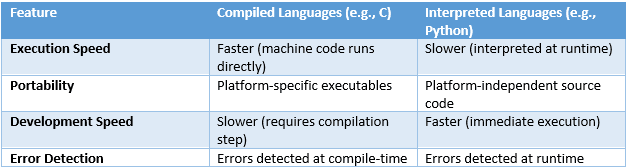
Comparing Compiled vs. Interpreted Execution
Real-World Implications for Developers
- Use Compiled Languages When: Performance is critical (e.g., game engines, system programming), or you need to enforce strict type-checking before execution.
- Use Interpreted Languages When: Rapid development, testing, or cross-platform support is needed, or you want the flexibility to modify and run code dynamically.
Pros and Cons of Compiled and Interpreted Languages
Compiled Languages
Pros:
- High Performance: Direct execution by the CPU.
- Better Error Checking: Errors caught before execution.
- Optimized Code: Compilation allows for various optimizations.
Cons:
- Slower Development Cycle: Need to recompile for changes.
- Platform-Specific Executables: Code may not run across different systems without recompilation.
Interpreted Languages
Pros:
- Ease of Development: No compilation step; run code immediately.
- Cross-Platform Compatibility: Write once, run anywhere.
- Dynamic Execution: Easier to test and modify code at runtime.
Cons:
- Slower Performance: Code is executed line by line.
- Runtime Errors: Errors occur during execution, which can lead to issues in larger applications.
Where Python Stands
Python sits in an interesting middle ground. While it is classified as an interpreted language, its bytecode compilation process improves performance compared to purely interpreted languages. This makes Python a popular choice for many use cases, from web development to data science, where development speed and ease of use often take precedence over raw performance.
Python’s approach to combining the flexibility of interpreted languages with an optimized bytecode execution model makes it a versatile tool in the developer’s toolkit.
Conclusion
The debate between interpreted and compiled languages comes down to a trade-off between performance and flexibility. While compiled languages like C offer speed and strict error checking, interpreted languages like Python provide ease of development and portability. Python, with its bytecode compilation, offers a blend of both worlds, making it a favorite for many developers despite not being as fast as purely compiled languages.
